
Saturday, December 22, 2007
Video: Andrey Novikov Requests Political Asylum
Yesterday I had an interview with the journalist Andrey Novikov, who since last February has been held against his will in psychiatric confinement on a spurious charge of "publicly inciting constitutional change by means of force." Press freedom watchdog Reporters without Borders comments that "Novikov has been the victim of practices contrary to the rule of law. ... It seems that Russia’s special services and psychiatrists are still empowered to take charge of anyone whose words or actions stray from the Kremlin line. The use of punitive confinement is very dissuasive for all those who might be tempted to express their disagreement with the authorities.”
Above is an exclusive video statement I got from Novikov in which he requests political asylum to escape the persecution he is suffering from in Russia. Stay tuned for more - Grigory Pasko.
0
comments
labels:
human rights,
russia,
torture,
videos

FBI aims for world's largest biometrics database
 The FBI is embarking on a $1 billion project to build the world's largest computer database of biometrics to give the government more ways to identify people at home and abroad, the Washington Post reported on Friday.
The FBI has already started compiling digital images of faces, fingerprints and palm patterns in its systems, the paper said.
In January, the agency -- which focuses on violations of federal law, espionage by foreigners and terrorist activities -- expects to award a 10-year contract to expand the amount and kinds of biometric information it receives, it said.
At an employer's request, the FBI will also retain the fingerprints of employees who have undergone criminal background checks, the paper said.
If successful, the system, called Next Generation Identification, will collect the biometric information in one place for identification and forensic purposes, the Post said.
(Reporting by Rachelle Younglai; Editing by John O'Callaghan)
0
comments
labels:
biometrics,
fbi,
privacy,
usa
Ministry of Homeland Security Developing X-Ray Snoop Device
 By Kurt Nimmo
It’s not enough they vacuum up your phone calls and emails, they know your medical history and financial transactions, now they want to look through your walls, right into the most private aspects of your life conducted behind closed doors.
“The lobster is at the forefront of the next new weapon in the war on terror: a handheld device that could help Homeland Security agents see through wood, concrete and steel,” reports Fox News. “Technology based on the crustacean’s uncanny ability to see through dark, cloudy, deep sea water is guiding scientists funded by the government in the early stages of developing a ray that one day could be used by border agents, airport screeners and the Coast Guard.”
Of course, it will be used as well to snoop people deemed a political threat by the government, as government is more concerned with the opposition than imaginary terrorists sneaking in the country by way of a port container. Border agents will not need such a device because it is their job to turn their backs while millions of illegals stream across the border.
David Throckmorton, a project manager in Homeland Security’s Science and Technology division, says a California company has developed a handheld prototype called the LEXID (Lobster Eye X-ray Imaging Device) that can see through walls.
The image, shown on a small screen, isn’t “high-definition TV quality,” Throckmorton says. But it’s good enough to pick up a cache of weapons or the parts for a bomb. It can also show a border agent if a person is crouched on the other side of a steel or concrete wall.
It might also be used to find weapons entirely legal under the Bill of Rights. If the drift of Congress is any indication — and possibly soon enough the drift of the Supreme Court — what is completely legal today may become illegal and thus subject to confiscation tomorrow. It is not too far out to imagine a Ministry sub-contracted thug from Blackwater with one of these soon-to-be perfected and manufactured devices scanning your home looking for the family shotgun. If you doubt this can happen, remember “deputized” Blackwater goons going door-to-door in New Orleans seizing entirely legal firearms.
There’s no estimate yet on how much each device would cost, but [Rick Shie, senior vice president at Physical Optics Corporation] says they hope to make it inexpensively enough so that it could have wide commercial appeal, including to pest control companies and contractors who need to look inside walls for rats or pipes.
And don’t forget the rats who oppose the neocons. Or for that matter their successors, be it Hillary or some other version of neolib dedicated to turn this country into a gulag same as the neocons.
But don’t worry — cost is no object, as the Ministry has already spent billions to destroy our Constitution and Bill of Rights.
Instead of calling this thing a “Lobster Eye X-ray Imaging Device,” we should call it a “Fourth Amendment Destruction Device,” as it seriously compromises our right to be secure in our persons, houses, papers, and effects, against unreasonable searches and seizures.
0
comments
labels:
inventions,
privacy
Saturday: 1 US soldier, 12 Iraqis Killed; 22 Iraqis Wounded
At least 12 Iraqis were killed or found dead and 22 more were wounded in the latest round of violence. Also, a pair of IEDs killed one MND-North soldier and wounded 11 more in Kirkuk. Meanwhile, U.S. troops left a base in Fallujah and arrested a wanted man from the Saddam regime in Hawija.In Baghdad, a suicide bomber attacked a Ghazaliya checkpoint, killing four people and wounding six more. A police officer was killed and two more were injured during security operations. In the Jamiya neighborhood, an Awakening Council member was gunned down as he was leaving a mosque.
Also in the capital, U.S. forces arrested a man believed to be an al-Qaeda "technical advisor." Meanwhile, a joint U.S.-Iraqi team raided Vice President Tareq al-Hashimi's Iraqi Islamic Party (IIP) al-Karkh headquarters. No casualties were reported, but the troops ransacked the building.
Police and gunmen clashed in Daqquq. Two gunmen were killed and one more was wounded. Two policemen were also wounded during the battle. An arms cache was found in a separate incident.
A pair of roadside bombs in Sinjar killed one policeman and wounded two others.
Five civilians were wounded during a bombing outside a Madaen hospital.
Witnesses saw U.S. troops fire upon a vehicle in Amiriyat al-Fallujah. The driver was killed and his companion was wounded. Troops then searched the vehicle.
A body belonging to a security guard, who worked for the minister of state for national security, was found in Iskandariya. Also, a police commando was gunned down, but his assailants were arrested.
Three family members were injured as mortar shelling severely damaged their home in Khalis.
An assistant to a former vice-president from the Saddam regime was arrested in Hawija.
In Fallujah, U.S. troops abandoned their base and reopened the streets of the Dubbat neighborhood to traffic.
Because of the combined Eid al-Adha and Christmas holidays, newspapers in Iraq have ceased publication until next Wednesday. News from the country may be scant until then.
Compiled by Margaret Griffis
0
comments
labels:
iraq,
usa,
war
Lab comes one step closer to building artificial human brain
 By Clint Witchalls
An ambitious project in Switzerland was scoffed at - but researchers have just succeeded in simulating a rat's brain in silicon.
In a laboratory in Switzerland, a group of neuroscientists is developing a mammalian brain - in silicon. The researchers at the Ecole Polytechnique Fédérale de Lausanne (EPFL), in collaboration with IBM, have just completed the first phase of an ambitious project to reproduce a fully functioning brain on a supercomputer. By strange coincidence, their lab happens to lie on the same shores of Lake Geneva where Mary Shelley dreamt up her creation, Dr Frankenstein.
In June 2005, Henry Markram, director of the Blue Brain project, announced his intention to build a human brain using one of the most powerful supercomputers in the world. "The critics were unbelievable," recalls Markram. "Everybody thought we were crazy. Even the most eminent computational neuroscientists and theoreticians said the project would fail."
Some of Markram's peers said there simply wasn't enough data available to simulate a human brain. "There is no neuroscientist on the planet that has the authority to say we don't understand enough," says Markram. "We all know a tiny slice. Nobody even knows how much we know."
Markram was not dissuaded by the negative reaction to his announcement. Two years on, he has already developed a computer simulation of the neocortical column - the basic building block of the neocortex, the higher functioning part of our brains - of a two-week-old rat, and it behaves exactly like its biological counterpart. It's something quite beautiful when you watch it pulse on the giant 3D screens the researchers have constructed.
The neocortical column is the most recently evolved part of our brain and is responsible for such things as reasoning and self-awareness. It was a quantum leap in evolution. The human brain contains a thousand times more neocortical columns than a rat's brain, but there is very little difference, biologically speaking, between a rat's brain and our own. Build one column, and you can effectively build the entire neocortex - if you have the computational power.
Although a neocortical column is only 2 millimetres long and half a millimetre in diameter, it contains 10,000 neurons and 30m synapses. The machine that simulates this column is an IBM Blue Gene/L supercomputer is capable of speeds of 18.7 trillion calculations per second. It has 8,000 processors and is one of the most powerful supercomputers in the world.
Markram believes that with the state of technology today, it is possible to build an entire rat's neocortex, which is the next phase of the Blue Brain project, due to begin next year. From there, it's cats, then monkeys and finally, a human brain.
Markram is banking on Moore's law holding steady, as a computer with the power of the human brain, using today's technology, would take up several football pitches and run up an electricity bill of $3bn a year. But by the time Markram gets around to mimicking a full human brain, computing will have moved on.
Modelling the future
Modelling seems to be the way forward for neuroscience. Each year, there are about 35,000 neuroscience papers published - and the number of papers being published is increasing at a rate of between 20% and 30% a year. Most neuroscientists only get to read about 100 of these papers a year, if they're lucky. Pouring all of this knowledge into Blue Brain seems an obvious way to use and preserve it.
Markram, a 44-year-old South African, first became interested in recording the electrophysiology of neurons when he was at the Max Planck Institute in Germany. He was recording two neurons and he saw them communicate. "I thought, my God, this is incredible, you can actually capture neurons communicating," he says. "Then I wanted to find out how they all communicated, so I started to map the whole circuit. It took 15 years." Markram describes the data he has collected over the past decade and a half as "too boring to be published".
The model is there to unify the data and test that it works. A neurobiologist who wants to test a certain theory of how a specific brain function, such as memory retention and retrieval, works can use Blue Brain to do so. The model will be open to the entire world's research community.
Simulation-based research becomes possible when you have a critical power of computation. Today, every commercial aircraft that is built started life as a simulation. Even cameras are simulated before they're built. In physics, we don't let off nuclear weapons any more, we just use simulations.
"We don't use simulation in life sciences because biology requires the most powerful computers," says Markram. "We do experiments on animals, but that is going to change in the near future and this project will drive that change."
One thing Markram is keen to stress is that this isn't another artificial intelligence (AI) system. "We're not looking for the brain of a robot," he says. "You can get an engineer to do that. They are much better at it and they can do it really quickly. But in the end, it [Blue Brain] will probably be much better. If we build it right, it should speak."
Decoding dysfunction
However, Markram is not holding his breath, waiting for some emergent consciousness to arise from the silicon brain. What he is after is something more prosaic, but also a lot more useful than a talking machine. By understanding the function of the brain, we can also begin to understand its dysfunction.
Disorders such as depression, schizophrenia and dementia are the price we pay for having complicated brains. "We don't understand what goes wrong inside those circuits," says Markram. "We're still in empirical medicine. If a drug compound works: good. If not, we try another one." Blue Brain could accelerate experimentation tremendously. It will be much more efficient than wet-lab experiments and it will reduce animal experimentation.
However, Steven Rose, emeritus professor of biology at the Open University, is sceptical that a biologically accurate model of the entire human brain can be built, given our current state of knowledge and technology. The integration between the different regions of the brain is just too complex to recreate on a computer simulation. "I'm not against people playing with models," says Rose, "but the idea that you can use it for anything very sophisticated as opposed to looking at real animals with real behaviour at the moment seems to me to be pie in the sky."
Rose warns against underestimating the difficulties that still remain. Then, rather grudgingly, he admits that the Blue Brain project is impressive. "Impressive but modest," he adds. Clearly, Markram still has some doubters to win over.
0
comments
labels:
brain,
technology
NORTHCOM: Constitution Not Important
 By Lee Rogers
The United States government is now actively directing the attention of the U.S. military towards the American people. Using the phony war on terror, the Department of Homeland Security and the U.S. Northern Command (NORTHCOM) are creating a militarized control grid specifically to enslave the American people. One thing is clear, neither of these agencies abide by the Constitution.In fact, both agencies by themselves are unconstitutional and should be abolished. Despite this, it is expected that they would at least try to follow the supreme law of the land which is the Constitution regardless of the unconstitutionality of the institutions themselves. Amazingly, NORTHCOM is now openly admitting that they do not follow the Constitution. NORTHCOM recently issued a press release talking about how they handle intelligence oversight and they stated that their goal in conducting intelligence oversight includes ensuring that presidential directives and executive orders are abided by during intelligence gathering operations. Of course, they don't specifically mention anything about abiding by the Constitution. This is disturbing considering the hundreds of unconstitutional executive orders issued by George W. Bush, Bill Clinton and others. In fact some even argue that executive orders by themselves aren't constitutional. If NORTHCOM is saying that the oversight of their intelligence gathering operations consist of ensuring these executive orders and directives are followed, than they are not concerned with following the Constitution.
The following is taken from NORTHCOM's press release on a recent intelligence oversight conference.
Safeguarding the privacy rights of U.S. persons is critical to the Department of Defense agencies that conduct intelligence activities in support of the nation’s homeland defense and homeland security.
To ensure the rights of all U.S. persons are protected, DoD established an Intelligence Oversight program to ensure that all military intelligence, counterintelligence, and intelligence related activities are conducted in accordance with applicable laws, presidential executive orders and DoD directives and regulations.
In its continuing effort to ensure compliance with the DoD IO program, North American Aerospace Defense Command and U.S. Northern Command sponsored the 1st Annual World-Wide Intelligence Oversight Conference Dec. 4-6 at Joint Task Force North Headquarters on Fort Bliss, Texas.
They admit that intelligence operations will be conducted in accordance with applicable laws, presidential executive orders and DoD directives and regulations. There are countless unconstitutional executive orders, so this admission means that they are not concerned with following the Constitution. If applicable laws include the Constitution, than how can they follow the Constitution and the many executive orders that are unconstitutional and unapplicable as it applies to the supreme law of the land?
NORTHCOM has already admitted that their goal is to form a militarized police state by the year by 2020 that will likely be used to control the domestic population of people within the United States, Canada and Mexico. They describe an apparent martial law apparatus for the coming North American Union superstate. NORTHCOM has also already conducted various martial law type exercises in preperation for a potential domestic insurrection. NORTHCOM has also stated that these exercises will continue and that they will become more sophisticated.
As reported by Blackanthem Military News, NORTHCOM is already starting to integrate their operations with various U.S. and Canadian federal agencies including with the Department of Homeland Security.
U.S. Northern Command is cementing a vast network of relationships critical to protecting the homeland against attacks or natural disasters and providing a unified response should one occur, its commander said today.
Since it was established a year after the Sept. 11, 2001, terrorist attacks, Northern Command has formed critical partnerships with the Department of Homeland Security, about 60 other U.S. and Canadian federal agencies and the states, Air Force Gen. Victor E. "Gene" Renuart Jr. said.
This is all very bad news for the American people who simply want the government to follow the Constitution. Not only is NORTHCOM admitting that they do not follow the Constitution but they are working to destroy the sovereignty of all three North American countries by integrating and forming partnerships with institutions within the different countries. Combined this with the fact that the Department of Homeland Security is attempting to implement a multi-billion dollar domestic spy satellite system along with all sorts of other unconstitutional surveillance programs and there is little doubt that a militarized control grid is being built around the American people.
NORTHCOM and the Department of Homeland Security should be abolished immediately. These institutions themselves are unconstitutional, they perform unconstitutional activities and NORTHCOM now has admitted that they don't follow the Constitution. These institutions will no doubt be used to further descend this country into absolute tyranny.
0
comments
labels:
abuses,
intelligence,
usa
CIA Fights Terror With GI Joe Action Figures

By Ethan Allen
‘Show me the money!’ A very appropriate cultural phrase to describe In-Q-Tel, a non-for-profit investment group that was originally chartered by the CIA, and has been run as a front group to further the agenda and plans of the CIA under the umbrella of public private partnership.
In-Q-Tel has had contracts with such companies as Pixim, a California based company that created microchips and DPS technology used in surveillance cameras and monitoring equipment, Destineer, a Minnesota based software developer that has made games such Close Combat: First to Fight (which was sanctioned by the CIA), Keyhole, who created some of the software used to create Google Earth, Gemalto, a company specializing in digital smart card technology, MetaCarta, makers of geotracker software, among others.
http://www.csoonline.com/read/030104/shop_2302.html
In-Q-Tel was started in 1999 by Gilman Louie, a venture capitalist with prior connections to the Intelligence community, and received the green light by the CIA to use In-Q-Tel to further its goals in the private sector, using black budget tax dollars, of course. In 2005 alone, In-Q-Tel was reported to have spent $65 million in tax money, all donated from the generous offices of the CIA, FBI, and DIA.
http://www.fas.org/irp/cia/news/pr093099.htm
Gilman has had his name on the CEO door of other ventures as well, including Hasbro, famous maker of Barbie and G.I.Joe. In fact, the toy and video game industry seems totally saturated with CIA and intelligence community investments. Peter Tamte, CEO of Destineer, while working on the Close Combat game, said, “to find commercial technologies that have use in our nation’s security. “We’re not building video games for the government. It’s strictly rooted in instruction.” Destineer was also not at liberty to discuss just how much money had been received by In-Q-Tel for funding, though it is estimated that In-Q-Tel itself receives somewhere between $40-$45 million a year from the CIA.
http://www.usatoday.com/tech/products/games/2005-06-15-cia-games_x.htm
And to keep the propaganda of global security and global government in the public’s mind, the current first draft script of the G.I.Joe movie includes a new acronym for the age-old fighting force. Instead of ‘Government Issue Joe’ fighting for American pride and freedom, G.I.Joe now stands for ‘Global Integrated Joint Security Operation Entity’; and to top it off, the COBRA villain, Cobra Commander, is now a CIA agent working both sides as an arms dealer and spy for the government. Can anyone say ’sting operation gone wrong’? The decades old tactics of false flag and hedge funding is now making its way into kids’ entertainment films. The current G.I.Joe screenwriter is Skip Woods, who also penned ‘Swordfish’, which followed a group of hackers trying to break into government databases who turn out to be rogue agents engaged in a covert operation without government approval. Is Hollywood trying to tell us something? Hey, Hollywood, we already know what the spooks are up to. Trying to spin villains into heroes won’t work. Not when actors such as these take the stage.
http://www.latinoreview.com/scriptreview.php?id=62
It would seem the Intelligence community is no longer content to just put agents in the field and follow the actions and black markets deals of bad guys in order to protect us. Now they must put agents in the field to follow other double agents, who may or may not be on the take. They also have to invest millions of public tax dollars in private corporations, all who seem to deal in some form of technology or property that involves controlling, influencing, or monitoring citizens. How are millions of dollars in tax dollars tossed into private ventures supposed to fight the frightening fang beast called Al(bert)-Qaeda? How is throwing millions into the pockets of private investors and capitalists supposed to make me safer? Apparently only Hasbro action figures can save us all from Bin Laden. The only result of these private public ventures seem to be more surveillance, more laws, and more control by the military/industrial complex.
0
comments
labels:
cia,
intelligence,
propaganda,
usa
Justifying the Iraq War: Why the NIE Is Wrong
by Gordon PratherIn case you thought that Bonkers Bolton was finally right about something – that the U.S. Intelligence Community had finally staged a "quasi-putsch," had finally stood up to the Likudniks and assorted neo-crazies hell-bent on launching a "pre-emptive" attack on Iran, had properly assessed the voluminous information the Iranians have made available (voluntarily or upon special request) to the International Atomic Energy Agency about Iran's nuclear programs, and had finally produced a thoroughly professional National Intelligence Estimate [.pdf] on Iran – think again.
First, there is this "assessment";
"We assess with high confidence that until fall 2003, Iranian military entities were working under government direction to develop nuclear weapons."
Followed by this "judgment";
"We judge with high confidence that in fall 2003, Tehran halted its nuclear weapons program."
Who's "We"?
Well, many of them are the same folks from the dozen or so "intelligence" gathering and analysis groups scattered throughout the Federal government who produced the October 2002 NIE on Iraq for George "Slam-Dunk" Tenet. (Or was it for Dick Cheney?)
That 2002 NIE totally ignored the best intelligence available on Iraq's nuclear programs, the publicly available IAEA reports, covering the years 1992-2002, documenting the destruction of Iraqi nascent capabilities to produce not-nearly-pure Uranium-235 and crude high-explosive implosion systems with which to compress the U-235 – if and when they ever managed to produce it – to super-criticality.
What that 2002 NIE on Iraq ought to have "assessed" was that until the fall of 1991, Iraqis were working under government direction to develop nuclear weapons.
Then, what that 2002 NIE on Iraq ought to have "judged" was that the first Gulf War and its immediate aftermath put an end to all Iraq's nuclear programs – peaceful and otherwise – and that in succeeding years no effort had been made to resurrect them.
And, finally, in the weeks and months immediately preceding the launch of President George W. Bush's war of aggression, to effect regime change in Iraq, when IAEA Director-General Mohammed ElBaradei and MOVIC Chairman Hans Blix, were regularly testifying before the UN Security Council that Iraq's Full and Final Declaration of its Weapons of Mass Destruction programs appeared to be full, final and accurate, "Slam-Dunk" Tenet just sat there on his hands, when he should have been trying to alert Congress that the 2002 NIE was fatally flawed.
But, this time, for the 2007 NIE on Iran – according to Scott Ritter, former Marine intelligence officer, UN inspector in Iraq, and author of Target Iran: The Truth About the White House's Plans for Regime Change – our intelligence community has been working closely with the IAEA inspectors in Iran.
After thousands of man-hours of go-anywhere see-anything inspections, at sites "declared" by the Iranians and at others, some military, suggested by our intelligence community, ElBaradei has declared there is "no indication" that Iran has a nuclear weapons program.
Consequently, a year or so ago our intelligence community sought to revise its 2005 NIE on Iran to reflect what the IAEA was not finding.
So, what's a member of the Cheney Cabal, hell-bent on bombing Iran – with nukes, if necessary – to do?
Well, after holding up its release for more than 10 months, allow our intelligence community to make public its 2007 revision, wherein they make no mention of the IAEA but "assess with high confidence that until fall 2003" ( when ElBaradei began his intrusive inspection campaign) "Iranian military entities were working under government direction to develop nuclear weapons."
[For the purposes of this Estimate, by "nuclear weapons program" we mean Iran's nuclear weapon design and weaponization work and covert uranium conversion-related and uranium enrichment-related work; we do not mean Iran's declared civil work related to uranium conversion and enrichment.]
"Military entities"?
Like, the Iranian Revolutionary Guard Corps?
The 125,000-strong elite military entity Bush recently sanctioned under Executive Order 13224 as a "specially designated global terrorist"?
Yep, that's the entity.
But, nuclear weapon design? Covert uranium-conversion? Covert uranium-enrichment?
Well, of course. As everyone knows; "Many of the front companies engaged in procuring nuclear technology are owned and run by the Revolutionary Guards."
How does everyone know that?
Surely you've heard about the "smoking laptop" and the Green Salt project.
According to the Washington Post, the only chronicled activity on that allegedly stolen Iranian laptop – which apparently is the principal basis of the 2007 NIE – that was clearly nuclear-related was the Green Salt Project.
"In the spring of 2001, a small design firm opened shop on the outskirts of Tehran to begin work for what appears to have been its only client – the Iranian Republican Guard. Over the next two years, the staff at Kimeya Madon completed a set of technical drawings for a small uranium-conversion facility, according to four officials who reviewed the documents.
"Several sources with firsthand knowledge of the original documents said the facility, if constructed, would give Iran additional capabilities to produce a substance known as UF4, or 'green salt,' an intermediate product in the conversion of uranium to a gas."
Well, if you want to know what a real intelligence professional thinks about the smoking laptop and the 2007 NIE on Iran, please – please – listen to Scott Ritter's December 6, 2007 interview on Antiwar Radio.
After listening to Ritter, you probably won't care much what Henry Kissinger or James Schlesinger or Bonkers Bolton think about it.
They're all extremely upset that the 2007 NIE excludes from Iran's alleged nuclear weapons program Iran's IAEA Safeguarded programs.
And you can see why.
As best the IAEA can tell, there is nothing nuclear in Iran that isn't IAEA Safeguarded, as the 2007 NIE now implicitly acknowledges. There's nothing covert – if there ever was – to bomb.
Hence, Kissinger's lament at the "extraordinary spectacle" of the President's National Security Advisor having to defend Bush's ongoing threats to "take-out" Iran's "nuclear weapons program" in the face of the 2007 NIE that judged there isn't one to "take out."
For Kissinger, Schlesinger and the Likudniks, the possible production of almost-pure Uranium-235 in Iran's Safeguarded facilities, for use in nuclear weapons, has been, by far, the greatest danger. Never mind that Iran could not possibly produce, unannounced and undetected, such almost-pure Uranium-235 in an IAEA Safeguarded facility.
In any case, Kissinger, Schlesinger and the Likudniks argue that the principal reason the Iranians "halted" their alleged nuclear weapons program in the fall of 2003 – if they, indeed, did – was that Bush launched his war of aggression on Iraq and they were afraid they would be next.
In other words, the 2007 NIE on Iran justifies Bush's war of aggression against Iraq.
Of course, if Scott Ritter is right, the Iranians never had a nuclear weapons program to halt. And, the Likudniks and the neocrazies have known that all along.
0
comments
labels:
conspiracies,
intelligence,
iran,
iraq,
usa,
war
Iran Polls Better Than US in Saudi Arabia
by Jim LobeAlthough the image of the United States appears to have improved in Saudi Arabia over the past year, the Saudi public's view of Washington remains largely negative, according to major new poll released here this week by Terror Free Tomorrow (TFT), a Washington, D.C.-based bipartisan group.
Indeed, less than 40 percent of some 1,000 Saudi respondents interviewed by telephone during the first week of December, said they have either a "very" or "somewhat favorable" opinion of the US, while nearly 52 percent said their view was either very or somewhat unfavorable, according to the survey results.
By contrast, Iran – which Saudi leaders reportedly consider a dangerous rival for influence in the oil-rich Gulf region – is seen more positively by the Saudi public in general, the poll found.
A plurality of 47 percent said they regarded Tehran either very or somewhat favorably, compared to 44 percent who expressed unfavorable views.
Strong majorities of Saudi respondents, on the other hand, said they held favorable views of Turkey (71 percent) – whose secular traditions would appear to be at odds with Saudi Arabia's staunchly Islamist orientation – and China (61 percent). Somewhat weaker majorities said they had positive views of France and Britain.
The TFT survey, the latest in a series by the organization of key countries in the Islamic world – including Iran and Pakistan – suggests that Saudi public opinion, especially toward the outside world, is considerably more complex than depicted by the western mass media which has portrayed it as a stronghold of "Wahabi" fanaticism.
Fewer than one in ten Saudis said they had a favorable opinion of al-Qaeda. Eighty-eight percent said they approved of their government's crackdown against the group and 15 percent said they had a positive impression of the group's chief and fellow-Saudi, Osama bin Laden.
But strong majorities of those who expressed a favorable opinion of bin Laden and al-Qaeda also said they favored closer ties between the US and Saudi Arabia and insisted that their views of the US would change for the better if Washington changed a number of its policies in the region.
More than two thirds (69 percent) of respondents said they favored better relations with the US
Asked what policy changes would improve their opinion of the US, 85 percent cited the withdrawal of US military forces from Iraq. Seventy-four percent cited increasing student and work visas for Saudis in the US and 71 percent suggested striking a free trade deal between the two countries.
Fifty-two percent of respondents said their view of Washington would improve if it brokered a comprehensive peace between Israel and the Palestinians, while only 36 percent cited Washington's efforts at promoting democracy in the Middle East.
Nearly two thirds (63 percent) said their view would improve if Washington provided more military assistance to Saudi Arabia, although only 49 percent said they favored the pending sale of billions of dollars in advanced US weaponry to the kingdom, while 32 percent said they opposed it.
While 52 percent of Saudi respondents said they retained a negative opinion of the US, that marked a considerable improvement over the results of a smaller TFT poll taken in May 2006 when 89 percent of Saudi respondents said they held an unfavorable view.
Still, TFT's director, Ken Ballen, said the 40 percent favorable view suggested that the Saudi public was one of the most pro-US countries in the region. He noted that only around 20 percent of respondents in surveys taken over the past year in Pakistan and Egypt said they had favorable views, while only nine percent of Turks shared that opinion in a May 2007 poll sponsored by the Pew Global Attitudes Project.
"From our surveys and others," he wrote in a summary analysis of the Saudi poll, "there are only two major Muslim majority countries with a higher favorable opinion of the United States: Bangladesh and Iran."
As heartening as that conclusion appeared to be, the US and Americans ranked were still seen least favorably among seven nations and their citizens on whom respondents were asked to give their opinions.
Only four in ten Saudis said they felt positively about Americans. Favorable opinions of the British were voiced by 48 percent of respondents. Fifty-two percent said they had favorable views of Iranians, while the French, at 57 percent, were viewed somewhat more favorably Nearly three out of four respondents said they had a positive view of Turks.
"It's not like they're locked into an anti-western framework," noted Steve Kull, director of the University of Maryland's Program on International Policy Attitudes (PIPA), citing the statistics for Britain and France.
Kull, whose organization has done extensive polling in the Middle East, also noted that the relatively favorable views towards Iran suggested that the Saudi public does not share the same fears about Tehran as the royal family.
Nearly one third of Saudi respondents said they had a favorable opinion of Iranian President Mahmoud Ahmadinejad – nearly three times the percentage of those who had positive views of Bush.
Still, 57 percent of respondents said they opposed the development by Iran of nuclear weapons. Thirty-eight percent said they would favor the US and other countries taking military action to prevent the Iranians from obtaining such a weapon, compared to 27 percent who said the US should accept a nuclear-armed Iran.
Saudis were particularly sympathetic toward Iraqis for whom more than four in five respondents expressed favorable views. Iraq also appeared to be the dominant source of unhappiness with the US.
Despite their strong antipathy toward al-Qaeda, 36 percent of respondents said they supported Saudi citizens going to Iraq to fight US forces there. Only 17 percent said they supported Saudis fighting Shi'ite militias in Iraq.
Saudi respondents expressed an almost uniform antipathy toward Jews. Only six percent said they held favorable views of Jews. Nearly nine of ten said their views were unfavorable (81 percent "very unfavorable").
A slight majority of 51 percent said they would oppose any peace treaty recognizing Israel, while 30 percent said they would favor such a treaty on the condition that Palestinians establish a state of their own.
Attitudes towards Christians were more divided. Forty-four percent expressed favorable views, while 54 percent said they had unfavorable opinions (40 percent "very unfavorable").
(Inter Press Service)
0
comments
labels:
iran,
saudi arabia,
usa
Shock and Tasers in New Orleans
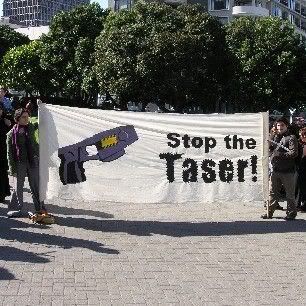 By Naomi Klein
The shameless exploitation of poor New Orleans residents to privatize public infrastructure is being enforced by violence and tasers.
Readers of my book The Shock Doctrine know that one of the most shameless examples of disaster capitalism has been the attempt to exploit the disastrous flooding of New Orleans to close down that city's public housing projects, some of the only affordable units in the city. Most of the buildings sustained minimal flood damage, but they happen to occupy valuable land that make for perfect condo developments and hotels.
The final showdown over New Orleans public housing is playing out in dramatic fashion right now. The conflict is a classic example of the "triple shock" formula at the core of the doctrine.
- First came the shock of the original disaster: the flood and the traumatic evacuation.
- Next came the "economic shock therapy": using the window of opportunity opened up by the first shock to push through a rapid-fire attack on the city's public services and spaces, most notably it's homes, schools and hospitals.
-Now we see that as residents of New Orleans try to resist these attacks, they are being met with a third shock: the shock of the police baton and the Taser gun, used on the bodies of protestors outside New Orleans City Hall yesterday.
Democracy Now! has been covering this fight all week, with amazing reports from filmmakers Jacquie Soohen and Rick Rowley (Rick was arrested in the crackdown). Watch residents react to the bulldozing of their homes here.
And footage from yesterday's police crackdown and Tasering of protestors inside and outside city hall here.
That last segment contains a terrific interview with Kali Akuno, executive director of the People's Hurricane Relief Fund. Akuno puts the demolitions in the big picture, telling Amy Goodman:
This is just one particular piece of this whole program. Public hospitals are also being shut down and set to be demolished and destroyed in New Orleans. And they've systematically dismantled the public education system and beginning demolition on many of the schools in New Orleans--that's on the agenda right now--and trying to totally turn that system over to a charter and a voucher system, to privatize and just really go forward with a major experiment, which was initially laid out by the Heritage Foundation and other neoconservative think tanks shortly after the storm. So this is just really the fulfillment of this program.
Akuno is referring to the Heritage Foundation's infamous post-Katrina meeting with the Republican Study Group in which participants laid out their plans to turn New Orleans into a Petri dish for every policy they can't ram through without a disaster. Read the minutes on my website:.
For more context, here are couple of related excerpts from The Shock Doctrine: The Rise of Disaster Capitalism:
The news racing around the shelter [in Baton Rouge] that day was that Richard Baker, a prominent Republican Congressman from this city, had told a group of lobbyists, "We finally cleaned up public housing in New Orleans. We couldn't do it, but God did." Joseph Canizaro, one of New Orleans' wealthiest developers, had just expressed a similar sentiment: "I think we have a clean sheet to start again. And with that clean sheet we have some very big opportunities." All that week the Louisiana State Legislature in Baton Rouge had been crawling with corporate lobbyists helping to lock in those big opportunities: lower taxes, fewer regulations, cheaper workers and a "smaller, safer city"--which in practice meant plans to level the public housing projects and replace them with condos. Hearing all the talk of "fresh starts" and "clean sheets," you could almost forget the toxic stew of rubble, chemical outflows and human remains just a few miles down the highway.
Over at the shelter, Jamar Perry, a young resident of New Orleans, could think of nothing else. "I really don't see it as cleaning up the city. What I see is that a lot of people got killed uptown. People who shouldn't have died."
He was speaking quietly, but an older man in line in front of us in the food line overheard and whipped around. "What is wrong with these people in Baton Rouge? This isn't an opportunity. It's a goddamned tragedy. Are they blind?"
A mother with two kids chimed in. "No, they're not blind, they're evil. They see just fine."
...
At first I thought the Green Zone phenomenon was unique to the war in Iraq. Now, after years spent in other disaster zones, I realize that the Green Zone emerges everywhere that the disaster capitalism complex descends, with the same stark partitions between the included and the excluded, the protected and the damned.
It happened in New Orleans. After the flood, an already divided city turned into a battleground between gated green zones and raging red zones--the result not of water damage but of the "free-market solutions" embraced by the president. The Bush administration refused to allow emergency funds to pay public sector salaries, and the City of New Orleans, which lost its tax base, had to fire three thousand workers in the months after Katrina. Among them were sixteen of the city's planning staff--with shades of "de Baathification," laid off at the precise moment when New Orleans was in desperate need of planners. Instead, millions of public dollars went to outside consultants, many of whom were powerful real estate developers. And of course thousands of teachers were also fired, paving the way for the conversion of dozens of public schools into charter schools, just as Friedman had called for.
Almost two years after the storm, Charity Hospital was still closed. The court system was barely functioning, and the privatized electricity company, Entergy, had failed to get the whole city back online. After threatening to raise rates dramatically, the company managed to extract a controversial $200 million bailout from the federal government. The public transit system was gutted and lost almost half its workers. The vast majority of publicly owned housing projects stood boarded up and empty, with five thousand units slotted for demolition by the federal housing authority. Much as the tourism lobby in Asia had longed to be rid of the beachfront fishing villages, New Orleans' powerful tourism lobby had been eyeing the housing projects, several of them on prime land close to the French Quarter, the city's tourism magnet.
Endesha Juakali helped set up a protest camp outside one of the boarded-up projects, St. Bernard Public Housing, explaining that "they've had an agenda for St. Bernard a long time, but as long as people lived here, they couldn't do it. So they used the disaster as a way of cleansing the neighbourhood when the neighbourhood is weakest. ... This is a great location for bigger houses and condos. The only problem is you got all these poor black people sitting on it!"
Amid the schools, the homes, the hospitals, the transit system and the lack of clean water in many parts of town, New Orleans' public sphere was not being rebuilt, it was being erased, with the storm used as the excuse. At an earlier stage of capitalist "creative destruction," large swaths of the United States lost their manufacturing bases and degenerated into rust belts of shuttered factories and neglected neighborhoods. Post-Katrina New Orleans may be providing the first Western-world image of a new kind of wasted urban landscape: the mould belt, destroyed by the deadly combination of weathered public infrastructure and extreme weather.
Since the publication of The Shock Doctrine, my research team has been putting dozens of original source documents online for readers to explore subjects in greater depth. The resource page on New Orleans has some real gems.
0
comments
labels:
conspiracies,
human rights,
katrina,
new orleans,
police,
taser,
usa,
weapons
Friday: 14 Iraqis Killed, 10 Wounded
Updated at 5:25 p.m. EST, Dec. 21, 2007
At least 14 Iraqis were killed and 10 more were wounded during a day of extremely light violence. No Coalition deaths were reported.
A suicide car bomber in Yusufiya killed four policemen and a civilian. Eight people were also wounded in the attack.
Three bodies were recovered in Baghdad.
Three hostages were freed and three gangs of kidnappers were arrested in separate incidents around Karbala.
A roadside bomb blasted a British vehicle near Basra. No casualties were reported.
Mortars fell south of Baquba on al-Salam where they killed one child and wounded two others.
In Balad Ruz, gunmen killed three people.
A man was kidnapped in al-Touz.
Mortars damaged a shop in Balad but no casualties were reported.
Coalition forces killed one suspect and detained 19 other during operations in northern and central Iraq.
Because of the combined Eid al-Adha and Christmas holidays, newspapers in Iraq have ceased publication until next Wednesday. News from the country may be scant until then.
Compiled by Margaret Griffis
0
comments
labels:
iraq,
usa,
war
Wearing Technology On Your Sleeve
 You think the switch from typewriter to computer was a revolution? The next stage could see many of us interacting with computers inserted into our very clothes. A new project is exploring a range of applications where wearable technology could significantly improve productivity and even help save lives.
"Assimilate, assimilate!” You trekkies out there will recognise the Borg mantra for the bloodcurdling ‘assimilation’ of humans by machines. On the other side of the sci-fi divide, many may recall Star Wars’ recently revived Darth Vader, the half-man, half-machine dark lord of intergalactic evil.
From science fiction to science fact, the pairing of man and machine has always been at the forefront of our fears of what the technological future might have in store. But it has also been the basis of many of our conceptions for dealing with the challenges of the future: efficient multi-medial communications, improved ecologically friendly transport and revolutionary medical applications. After all, for every space villain there is a light sabre ready to be used to chop his head off.
Today’s instances of the association between man and technology are perhaps not as impressive to the jaded cinemagoer, but just as ambitious for the impact they could have on our daily lives. The focus, though, is perhaps not so much on assimilation as it is on integration and usability European researchers have been carrying out wide-ranging testing of new wearable technology with applications in a variety of fields and with the potential of protecting and even saving lives. The vital innovation is that the technology facilitates a new form of human-computer interaction comprising small, easily accessible body-worn computers that are always on and always responsive.
If you have a desktop application, then there is always a screen, a keyboard and a computer unit, but if you have a wearable computing solution, then it can be completely different,” says Michael Lawo, technical manager of the WearIT@work project. “You can have speech control in one instance, gesture control in another, though the application should always be the same,” he says. The Open Wearable Computing Framework being developed essentially comprises a central, easily wearable and hardware-independent computing unit which gives access to an ICT environment. Some of the basic components include wireless communication, positioning systems, speech recognition, interface devices, and low-level software platforms or toolboxes allowing these features to work together.
New paradigm
The pattern of this EU-funded project is woven as much out of applications as it is technology. It uses a number of commercial, off-the-shelf components and brings them together to create a new tool with the potential to revolutionise the way we work.
“Wearable computing is a completely new working paradigm,” says Lawo. “It is a technology which can support you in a particular environment. Instead of working at the computer, you are directly supported by the technology, a bit like when you are driving a car and you get information from the navigation system supporting you in your primary tasks.”
WearIT@work, the largest civilian wearable computing effort worldwide, is currently being tested in four different fields. These include aircraft maintenance, emergency response, car production and healthcare. Pilot projects in the areas of bush-fire prevention, e-inclusion and cultural heritage have also recently been launched.
In most cases, the technology is being applied to people who are not accustomed to using computers at the workplace, such as blue-collar workers. “The basic idea was to make the technology available to the workers and directly improve productivity,” says Lawo.
“We address fields where there are no similar applications today. Take the example of an aircraft technician. There is a person doing paperwork who has to find the relevant documentation on a computer. He has to find the aircraft maintenance manual and the parts manual, and produce a printout. These documents are handed over to the technician who then goes to the aircraft to do his work. He then has to write a report on a sheet of paper. And that is the way things work today. What we are doing is giving the worker support and direct access to the ICT system from the workplace. We get rid of the paper.”
Working with fire
With a considerable number of applications potentially possible, perhaps the most challenging test case for the project is the one involving emergency response teams, in collaboration with the Paris Fire Brigade. The technology helps support the communication, collaboration and information processes of rescue forces.
The efficiency and safety of firemen can be considerably improved by a number of light, easy-to-use and resistant devices, such as biosensors monitoring their physiological condition and improved localisation of hazards, personnel and retreat paths.
The technology has largely been well received by workers. “They recognise that this is a new technology where you can monitor working activities, but they do not hesitate to use it, and they see the advantage of it,” says Lawo.
Difficulties might nonetheless emerge in the future. “As soon as you come to the actual introduction of the technology and start negotiating with the unions, privacy will undoubtedly be an issue,” says Lawo.
WearIT@work already has some 42 partners, including IT giants Microsoft, Hewlett-Packard and Siemens, but Lawo says the project is always on the lookout for new ventures.
“Research will continue for components or for positioning systems. There is a lot of further research that can be carried out, but you can basically already do quite a lot with the application and with the technology that already exist,” he confirms.
Testing is due to continue until mid-2008 and will be followed by an initial 12-month period where the focus will shift to exploitation. “What we really want to do is introduce the system into everyday working methods,” says Lawo.
Adapted from materials provided by ICT Results.
0
comments
labels:
technology,
weapons
Opposition Leader Conscripted in Moscow, Demonstrators Beaten
 OMON Special Forces have violently dispersed a sanctioned opposition protest in Moscow, the Sobrok@ru news agency reports. Around 40 people had gathered in Arbat square, coming together to speak out against violations in the December 2nd State Duma elections. The demonstrators also brought signs to show support for Oleg Kozlovsky, a leader of the Oborona youth movement.
On December 20th, Kozlovsky was apprehended near his house by a district militsiya officer, and taken to the local military enlistment office. Young men in Russia are required to serve as conscripts in the Russian army, although exemptions are made for University students, and students may train to become reserve officers instead. Kozlovsky had completed training courses at Moscow State University, and was certified into the officer corps.
The enlistment office claimed to have lost Kozlovsky’s documents, and proceeded to question him. Subsequently, he was illegally enlisted into the army as a common soldier. Kozlovsky was also subjected to a medical examining board, which ignored a medical condition that excludes him from service. He has since been sent to a military base to start his service.
Roman Dobrokhotov, another youth leader who attended the protest, said:
“Oleg Kozlovsky is my friend, and we have organized political actions together many a time. It is apparent to me, that if a person with medical issues, who is studying at University and holds the rank of reserve officer suddenly finds himself at a military enlistment office – that is a political order from above.”
The peaceful demonstration lasted only half an hour. Swinging night sticks, officers charged the demonstrators, hauling some 20 people off onto waiting mini-buses. Their crime is described as changing the subject of the picket from what it was registered as. As yet it remains uncertain whether any of the protestors were seriously injured.
The Other Russian coalition has denounced the arrests, and has said that Kozlovsky’s detention was politically motivated. “We take note that the Oleg Kozlovsky’s forcible dispatch to the army represents yet another method in the campaign against political activists. It stands side by side with murders, beatings, forced psychiatric hospitalization, threats, arrests, shake-downs, and other,” the coalition’s press-release stated.
0
comments
labels:
human rights,
omon,
police,
russia
The Voice of God Weapon Returns
By Sharon Weinberger
The Voice of God weapon -- a device that projects voices into your head to make you think God is speaking to you -- is the military's equivalent of an urban myth. Meaning, it's mentioned periodically at defense workshops (ironically, I first heard about it at the same defense conference where I first met Noah), and typically someone whispers about it actually being used. Now Steven Corman, writing at the COMOPS journal, describes his own encounter with this urban myth:
At a government workshop some time ago I head someone describe a new tool that was described as the “voice of Allah.” This was said to be a device that would operate at a distance and would deliver a message that only a single person could hear. The story was that it was tested in a conflict situation in Iraq and pointed at one insurgent in a group, who whipped around looking in all directions, and began a heated conversation with his compatriots, who did not hear the message. At the time I greeted this story with some skepticism.
Is there any basis to this technology? Well, Holosonic Research Labs and American Technology Corporation both have versions of directed sound, which can allow a single person to hear a message that others around don't hear. DARPA appears to be working on its own sonic projector. Intriguingly, Strategy Page reports that troops are using the Long Range Acoustic Device as a modified Voice of God weapon:
It appears that some of the troops in Iraq are using "spoken" (as opposed to "screeching") LRAD to mess with enemy fighters. Islamic terrorists tend to be superstitious and, of course, very religious. LRAD can put the "word of God" into their heads. If God, in the form of a voice that only you can hear, tells you to surrender, or run away, what are you gonna do?
And as Corman also notes, CNET recently wrote about an advertisement in New York for A&E's TV show Paranormal State, which uses some of this technology. Beyond directed sound, it's long been known that microwaves at certain frequencies can produce an auditory effect that sounds like it's coming from within someone's head (and there's the nagging question of classified microwave work at Brooks Air Force Base, that the Air Force stubbornly refuses to talk about).
That brings us back to the Voice of God/Allah Weapon. Is it real or bogus? In one version -- related to me by another defense reporter -- it's not just Allah's voice -- but an entire holographic image projected above (um, who decides what Allah looks like?).
Does it exist? I'm not sure, but it's funny that when you hear it brought up at defense conferences, no one ever asks the obvious question: does anybody think this thing will actually convince people God is speaking to them? I'm thinking, not.
0
comments
labels:
conspiracies,
technology,
weapons
Thursday: 1 US Soldier, 53 Iraqis Killed; 51 Iraqis Wounded
Updated at 12:02 a.m. EST, Dec. 21, 2007
A U.S. soldier is among the dead in a suicide bombing that killed over a dozen Iraqis in Diyala province. Another bomb in Baghdad injured almost 30 people as well as killing three others. Overall, at least 53 Iraqis were killed and another 51 were wounded throughout Iraq. Meanwhile, the killing of an Iraqi policeman in a knife fight with a Marine led to a protest in Ramadi.
A suicide bomber in Kanaan killed one U.S. soldier and 13 Iraqis, who were part of an Awakening Council. Another ten U.S. soldiers and 18 Iraqis were wounded at a building that houses the headquarters of this U.S.-linked patrol group.
In Baghdad, a car bomb left outside a liquor store on Saadoun Street killed three people and wounded 27 others. A dumped body was found in Shaab, and another was discovered in Saidiya.
A roadside bomb targeting a joint police and army patrol in Baquba killed one Iraqi soldier and wounded a second. Gunmen killed a civilian in a separate incident. Late Thursday, a homemade bomb and small arms fire left a policeman, an Iraqi soldier and two Awakening Council members dead.
Three children were injured during a roadside bombing meant for a U.S. patrol working in Fallujah.
A motorcycle ban was imposed in Wassit province during the Eid al-Adha holiday.
In Basra, two female hostages were released in separate incidents. Their kidnappers were arrested. The city is suffering from armed militias that are targeting women who are not dressing in accordance with Muslim traditions.
Government officials in Diwaniya ordered that concrete barriers and watchtowers be removed off some city streets to ease the traffic conditions.
In Hashimiyat, two gunmen were killed during a clash with Iraqi army troops.
Dozens of protestors demonstrated in Ramadi against the killing of an Iraqi policeman during a knife fight with a U.S. Marine.
Three gunmen were killed and two more wounded during security operations conducted by Iraqi forces; 27 suspects were detained. Twenty-two suspects were killed during separate operations conducted by U.S. troops and Iraqi policemen in Diyala province. U.S. soldiers captured three suspects they believe were using Iranian weapons. Combined U.S.-Iraqi forces detained 23 people in Iskandariya. A commissioner was arrested in connection with a prison escape. Meanwhile, another 100 detainees were released from Camp Cropper after it was determined that they pose no threat.
Because of the combined Eid al-Adha and Christmas holidays, newspapers in Iraq have ceased publication until next Wednesday. News from the country may be scant until then.
Compiled by Margaret Griffis
0
comments
labels:
iraq,
usa,
war
Iraq, Afghanistan War Costs Top Vietnam
Congress' approval Wednesday of $70 billion more for the wars in Iraq and Afghanistan mean the twin conflicts are now more costly to American taxpayers than the war in Vietnam.
According to a study by the Washington-based Center for Arms Control and Non-Proliferation, Congress has now approved nearly $700 billion for the wars in Iraq and Afghanistan.
"Using inflation-adjusted dollars, the total cost of those wars has now surpassed the total cost of the Vietnam war (which ran to $670 billion)," the group's Travis Sharp told OneWorld. "It's also more than seven times larger than the Persian Gulf War ($94 billion) and more than twice the cost of the Korean war ($295 billion)."
As a result of Wednesday's vote, Sharp said, the wars in Iraq and Afghanistan will become the second costliest conflict in American history, trailing only World War II.
"But that was a time when 12 million Americans served, as compared with 1.42 million active duty soldiers and just over one million National Guard and reservists today," Sharp added.
Much of the money approved by Congress will go to buy expensive new military equipment: $922 million is earmarked for purchase or alteration of 41 new Blackhawk, Apache, and Chinook Helicopters; $813 million will be spent on new Bradley Fighting Vehicles; $455 million for new Humvees; $427 million on new Heavy Tactical Vehicles; and $425 million for M1 Abrams Tanks.
"I think what you're seeing from Democrats is a resignation to the fact that they're going to have to wait for the Bush Administration to leave office before they see any serious change in the country's war policy," Sharp said. "The Democrats just want to play out the clock on this one."
But "playing out the clock" comes with a severe cost for essential services at home.
Even before the new $70 billion dollars was approved Wednesday, the Massachusetts-based National Priorities Project had estimated that the average American household has already spent $4,100 on the Iraq war.
This year alone, US taxpayers spent $137.6 billion on the Iraq war. For the same amount of money, the government could have provided more than 39 million people with health care, built one million units of affordable housing, or outfitted 142 million homes with renewable electricity sources.
"We want to help people comprehend the magnitude of these numbers," said the group's Pamela Schwartz. "Surely, ultimately, we'd hope that our priorities would shift so that significantly less money is going to war with more money going to programs like heath care, Headstart, and education."
"We want to help people understand that choices are being made here," she added.
To that end, the National Priorities Project has set up a web-site, Costofwar.com, where taxpayers can learn what the cost of the Iraq war has meant to their community. Visitors to the website can search by state, city, or congressional district and find out how much money the Iraq war has taken out of their community and where the money could have gone instead.
For example, taxpayers in Chicago have spent $4.8 billion on the war in Iraq – money that could have been used to build 567 new elementary schools or build 35,000 units of affordable housing.
In smaller places like George W. Bush's hometown of Crawford, Texas, war spending has also had a strong impact. Crawford's taxpayers have spent $1.3 million on the war in Iraq – money that could have been used to provide 180 full scholarships for university students, or hire 30 additional police and sheriff's deputies.
"The Democrats were elected last year with a certain set of priorities, but President Bush drew a line in the sand," Schwartz told OneWorld. "Rather than drawing their own line, Democrats respected Bush's line. They met President Bush's spending limits on domestic programs and gave him a blank check for the Iraq war. That's the choice they made."
(OneWorld)
0
comments
labels:
afghanistan,
iraq,
usa,
war
Friday, December 21, 2007
Niger: Army, rebels commit abuses against civilians, rights groups say
Amnesty International says at least 13 civilians have been ''unlawfully'' killed by Niger's security forces in the last four weeks.
DAKAR, 20 December 2007 (IRIN) - The Nigerien army and rebels in the country have yet to formally respond to charges by rights groups that both sides are committing abuses against civilians.
“To my knowledge, there have been no crimes,” said Oumarou Boubacar, an army commander in Agadez in northern Niger where the crimes are alleged to have taken place.
"We are an evolved army. We respect humanitarian law," he told IRIN by phone on 20 December.
Human Rights Watch (HRW) and Amnesty International released statements on 19 December accusing the Nigerien army of extrajudicial killings, mostly in reaction to rebel raids. HRW said the rebels have used landmines and robbed civilians.
The rebel Nigerien Movement for Justice (MNJ) has attacked government outposts in the isolated north, purportedly to seek a greater portion of Niger’s uranium revenues and more equitable treatment for the ethnic Touareg living in the area.
HRW called on both sides to cease what it calls "deliberate and indiscriminate attacks against civilians".
Since armed conflict began in February, rights groups have accused the rebels of laying landmines indiscriminately. The mines have reportedly killed at least 49 soldiers in recent months. HRW says that of 80 people killed and injured, nearly one-fifth were civilians.
Amnesty International says at least 13 civilians have been “unlawfully” killed by Niger’s security forces in the last four weeks.
HRW spoke with civilians who said they witnessed soldiers assaulting civilians. “One day I was getting water in one of the wells in town when, just down the road, a military vehicle ran over a landmine,” a young woman who fled the northern town of Iférouane told HRW.
“After this, the soldiers went crazy and started shooting everywhere in the air – here, there and all over the village. They went into people’s houses looking for the ones who planted it and beat people they came across,” she said.
When IRIN contacted Communication Minister Mohamed Ben Omar he said, “We have no information for you at the moment” and hung up the phone. Reuters has reported that Ben Omar said the government would respond to the rights groups' charges on 21 December.
However according to various news service reports the government has admitted to “accidentally” killing seven civilians in a firefight between MNJ and army forces on 9 December.
Rebel responsibility
Rebels interviewed by HRW admitted to placing landmines on major roads around Agadez, Iférouane and Arlit. “[The rebels] claimed they were aiming to target military vehicles [but] including those used to escort civilian convoys,” the HRW report says.
The rebels are also suspected of having placed landmines that killed two civilians in the southern cities of Maradi and Tahoua on 10 December.
The MNJ denies responsibility, blaming the army instead. “There is no element of the MNJ that would target civilians,” the group’s spokesperson in Belgium, Moktar Roman, told IRIN following the incidents.
Humanitarian impact
While not widespread or systematic, the number of abuses by both sides appear to have increased in the last two months, Corinne Dufka, West Africa researcher for HRW, told IRIN.
The HRW and Amnesty reports corroborate recent observations by local and international aid workers that Touareg residents in Iférouane – an army town in rebel-controlled territory – have fled en masse.
Many are arriving in Arlit and Agadez and receiving little assistance, the local NGO SOS-Iférouane told IRIN.
Dufka said the army has allegedly killed people’s livestock as collective punishment. “The Touaregs are so dependent upon their livestock for their survival,” she told IRIN. “We’re quite concerned that, in combination with increased commodity prices [due to the lack of trade caused by the conflict], that could really create a hunger issue.”
The human rights groups also accuse soldiers of committing at least two rapes and 35 arbitrary detentions while rebels are accused of robbing people from southern ethnic groups.
ha/dh
0
comments
labels:
human rights,
niger
Lobster serves as model for new X-ray device that sees through walls
By Mimi Hall
The lobster is at the forefront of the next new weapon in the war on terror: a handheld device that could help Homeland Security agents see through wood, concrete and steel.
Technology based on the crustacean's uncanny ability to see through dark, cloudy, deep sea water is guiding scientists funded by the government in the early stages of developing a ray that one day could be used by border agents, airport screeners and the Coast Guard.
David Throckmorton, a project manager in Homeland Security's Science and Technology division, says a California company has developed a handheld prototype called the LEXID (Lobster Eye X-ray Imaging Device) that can see through walls.
The image, shown on a small screen, isn't "high-definition TV quality," Throckmorton says. But it's good enough to pick up a cache of weapons or the parts for a bomb. It can also show a border agent if a person is crouched on the other side of a steel or concrete wall.
The patented device, which radiates objects with tiny amounts of X-ray energy, is "modeled exactly after the lobster living in the deepest, darkest part of the ocean," says Rick Shie, senior vice president at Physical Optics Corporation, which is developing the LEXID.
A lobster's eyes, which look like small antenna, are made up of thousands of tiny square channels that allow the eyes to focus by reflection, rather than by refraction — or the bending of light — as human eyes do.
That unique optical geometric design, which allows lobsters to see in the dimmest light, is being adapted into a "lobster-eye lens" that focuses the X-ray images so that the device can actually see through a wall and project an image of what's on the other side.
Shie says his company hopes to have the device perfected within a year so that Homeland Security agents can test it on the job.
There's no estimate yet on how much each device would cost, but Shie says they hope to make it inexpensively enough so that it could have wide commercial appeal, including to pest control companies and contractors who need to look inside walls for rats or pipes.
At Homeland Security, which has so far invested just under $1 million in the research, the LEXID could help members of the Coast Guard who inspect ships for weapons, drugs and stowaways. It could also help airport workers who check the crates loaded onto passenger planes and seaport inspectors concerned about the contents of the large metal cargo containers being taken off foreign ships, Throckmorton says.
If a ship manifest says that a particular container is supposed to be filled with boxes, he says, the LEXID would allow an inspector to make sure it's not full of 55-gallon drums.
Shie says the device could help agents find all kinds of hidden contraband. "That's how the guys that don't like us fund their work," he says. "And they're pretty sneaky."
0
comments
labels:
inventions,
privacy
Bush's Torture Policy Is a Cancer
By Brent Budowsky
Increasingly, U.S. government officials, including senior military officers, must go through verbal gymnastics to avoid implicating George W. Bush in an obvious crime: the authorization to torture al-Qaeda suspects.
In this guest essay, former congressional staffer Brent Budowsky warns that the rhetorical gyrations are now endangering U.S. troops:
In unprecedented congressional testimony, Brig. Gen. Thomas Hartmann recently refused to say it would be illegal for American POWs to be tortured through waterboarding by our enemies.
He couldn’t because a policy claimed to be legal when committed by our government would be equally legal when committed by our enemies against our troops and POWs.
The legal perversion of Gen. Hartmann’s testimony would outrage American military families.
It dramatizes how alien this torture policy is from two centuries of American military and legal tradition, when an American general cannot defend the time honored rights of American POWs, and America’s enemies could use his testimony as their defense for torture against our troops.
From the days of George Washington, every president, every Congress and every Supreme Court has believed that torture is illegal and violates cardinal American values.
From the days of the Continental Army until today, torture has been opposed by virtually every commander of every branch of military service. …
Of course, the CIA destroyed the torture tapes that were sought as evidence by the 9-11 Commission, courts and Congress.
They were destroyed because they were evidence of abuses that the weight of legal opinion would conclude constitutes criminal conduct under international and American law. Their destruction probably constitutes obstruction of justice.
Torture is a cancer that metastasizes to everything it touches.
Our international credibility collapses. Our POWs are exposed to grave new dangers. The destruction of evidence becomes inevitable. The obstruction of justice becomes a reality and the inevitably failed cover-up is exposed.
Torture corrupts the military chain of command. Civilians who never served in the military order uniformed officers to commit acts that they strongly oppose.
Torture corrupts military justice by creating a super-secret infrastructure of detention centers that enable torture, morphing into an infrastructure of secret courts and secret evidence that almost inevitably lead to secret crimes that are ultimately exposed.
It is no coincidence that Attorney General Michael Mukasey pursues the doctrine of his predecessor, Alberto Gonzales, trying to exclude Congress yet again, in yet another attack on constitutional checks and balances.
An independent counsel is clearly needed because the Justice Department and CIA have been thoroughly integrated into the actions and justifications for the practices under investigation.
There is no credence when government agencies so thoroughly integrated into the torture policy investigate themselves without independent review. This constitutes not merely the extreme perception of conflict of interest, but the extreme reality of conflict of interest.
This conflict is even more draconian because of the unexplained reversal of position by the Attorney General himself between his first and second days of testimony during his confirmation hearings.
Military families oppose torture because they have a profound respect for military honor, military justice and military values. Like every previous generation of American presidents and American commanders, they know that torture endangers those they love, who serve so bravely.
0
comments
labels:
bush,
torture,
usa
Cocaine Jet That Crashed in Mexico Part of Cowboy Government Operation, DEA Sources Claim
By Bill Conroy
The Gulfstream II jet that crash landed in the Mexican Yucatan in late September carrying close to four tons of cocaine was part of an operation being carried out by a Department of Homeland Security agency, DEA sources have revealed to Narco News.
The operation, codenamed “Mayan Express,” is an ongoing effort spearheaded by U.S. Immigration and Customs Enforcement (ICE), the sources claim. The information surfaced during a high-level meeting at DEA headquarters in mid-December, DEA sources familiar with the meeting assert.
Those sources have requested anonymity out of fear they will be retaliated against by the government for revealing the information.
The operation also appears to be badly flawed, the sources say, because it is being carried out unilaterally, (Rambo-style), by ICE and without the knowledge of the Mexican government — at least it was up until the point of the coke-packed Gulfstream jet’s abrupt impact with the Earth.
“This is a case of ICE running amok,” one DEA source told Narco News. “If this [operation] was being run by the book, they would not be doing it unilaterally” – without the participation of DEA – “and without the knowledge of the Mexican government.”
The fact that the Gulfstream was forced to ditch over the Yucatan after being refused landing clearance at two Mexican airports is strong evidence that this operation, if ICE operated as alleged, does not have the proper controls in place, law enforcement sources told Narco News. If the operation was being adequately monitored and controlled by U.S. law enforcement, in coordination with Mexican authorities, the jet would have been directed to a safe landing zone, they add.
Mexican law enforcers subsequently apprehended the two pilots of the downed jet. Neither one of them appears to be a U.S. citizen, according to Mexican press accounts.
Narco News has previously reported that the bill of sale for the Gulfstream jet — which was sold only weeks before its crash landing — lists an individual named Greg Smith, whose name also shows up in public documents that indicate he worked as a pilot in the past for an operation involving the FBI, DEA and CIA that targeted narco-traffickers in Colombia. [See link here.]
Mexican authorities interrogated the pilots of the ill-fated cocaine jet prior to turning them over to DEA agents for questioning. DEA confirmed that it is now handling the investigation into the jet crash and subsequent seizure of the cocaine.
It appears that the pilots spilled the beans on the ICE operation during their interrogation by Mexican authorities, DEA sources tell Narco News. The meeting held at DEA headquarters was focused, in part, on assessing the implications of that information. The Mexican government has chosen not to raised a stink over the matter, the DEA sources claim, for fear of jeopardizing the pending $1.4 billion U.S. aid package promised as part of the proposed “Mérida Iinitiative” — commonly known as “Plan Mexico,” which will provide a Christmas list of training and equipment to the Mexican government to battle “drug cartels.”
Mexican law enforcement authorities recently arrested an alleged money launder, Pedro Alfonso Alatorre Damy, who they contend is linked to the Sinaloa narco-trafficking organization. They claim the narco-trafficking organization financed the purchases of the Gulfstream II as well as a DC-9 jet that was busted by Mexican authorities last April with a payload of some 5.5 tons of cocaine. Both jets were sold while parked at the St. Petersburg-Clearwater International Airport, according to a recent report by Howard Altman of the Tampa Tribune.
So, there is clearly a connection between the two jets. The thread that ties the Sinaloa organization, Greg Smith and the U.S. federal agencies that appear to have been involved together, however, remains very unclear. Did the cartel hire Smith and Clyde O’Connor (the other individual listed on the Gulfstream’s bill of sale) to handle the plane’s purchase, unaware that it was falling into a sting? Was the Sinaloa organization’s connection to the planes simply invented by authorities as part of a cover-up of the operation? Or is there another explanation yet to be found?
The alleged involvement of ICE in a unilateral counter-narcotics operation in a foreign nation is unusual (though not unprecedented) because DEA is supposed to be the lead U.S. agency in such efforts. ICE, however, generated a major controversy when it ran an operation several years ago targeting the Vicente Carrillo Fuentes (VCF) narco-trafficking organization in Juarez, Mexico. As part of that operation, ICE placed an informant (a former Mexican cop) inside a VCF cell in Juarez and continued the operation even after ICE agents became aware of their informant’s participation in murder.
That case, since dubbed the House of Death resulted in some 12 people being tortured, murdered and buried in the back yard of a house in Juarez – all in an effort to make a drug case against a VCF lieutenant. As is alleged with the current Mayan Express operation, ICE officials were accused of running the House of Death case unilaterally and going to great lengths to conceal information about their informant and the murders from the Mexican government.
ICE public affairs officials in Washington, D.C., failed to reply to several inquiries (by phone and e-mail) from Narco News seeking comment on the alleged Mayan Express operation.
Narco News also contacted Steve Robertson, a special agent assigned to DEA public affairs in Washington, D.C., for comment about the allegation that the Gulfstream II jet that crashed in Mexico in late September with some four tons of coke onboard was, in fact, part of an ICE operation.
Robertson’s response:
I can’t confirm or deny that it was an ICE operation — even if I knew it was the case, and I’m not saying it’s true.Our Mexico City office is working an investigation on it now. It started after the seizure [the jet crash]. It’s an ongoing investigation.
… It was not a DEA operation. The briefings I’ve gotten is that our investigation started after the seizure.
Out of Control
The structure of the Mayan Express operation, as outlined by the DEA sources, puzzles law enforcement officials contacted by Narco News. The operation appears to be playing out in Mexico and Colombia (where the cocaine was picked up) absent any tight law enforcement controls. As a result, the law enforcers agree, any criminal cases that might result from the effort likely could only be pursued once the cocaine entered the United States via an ICE-controlled delivery point, given the laws governing complex international narcotics investigations.
The apparent lack of control of the operation south of the U.S. border also raises questions as to how much of the cocaine made its way into the United States unchecked due to the mechanizations of crafty informants and assets involved in the operation or the indifference of federal agents looking to advance a career-boosting case. In the case of the House of Death, the informant actually smuggled a 100 pounds of marijuana across the U.S. border behind the backs of his ICE handlers, yet ICE continued to use the informant.
The bottom line, though, according to the DEA sources who leaked the information to Narco News, is that the real purpose of the Mayan Express operation remains unclear, as does the volume of drugs involved in the operation to date.
Spooks at the Levers
One proposition that all of the law enforcers who spoke with Narco News agreed on with respect to the Mayan Express is that even if DEA was precluded from participating in the effort, the CIA almost certainly was involved on some level. They say no law enforcement operation is carried out overseas without the CIA lurking in the background.
Some U.S. media have reported that the Gulfstream II jet that crashed in Mexico in September is suspected of possible links to the CIA’s terrorist rendition program and that the aircraft made several trips to Guantanamo Bay in years past — prior to being enlisted as a cocaine transport plane.
Confirming that information independently has proven difficult, but Narco News did find a report from a British government agency that lists the Gulfstream II’s registration number (N987SA) among the aircraft registration numbers European investigators were interested in obtaining more information about in relation to a probe into CIA rendition flights.
Information on N987SA — along with a number of other jets — was released to the Parliamentary Assembly of the Council of Europe in June 2006 by Britain’s Department of Transport.
From the British agency’s Web site:
On 7 April the Government published flight plan data received from Eurocontrol, the European Organization for the Safety of Air Navigation, concerning the movement of certain US aircraft into or out of UK aerodromes since 1 January 2001. This data had previously been released by Eurocontrol to the Parliamentary Assembly of the Council of Europe to assist with its enquiry into allegations of “extraordinary rendition” flights operating within Europe. It provided information on the aircraft’s type, registration number, date and time of flight, point of origin and destination and recorded user’s name. It did not however contain information about any passengers on board or the purpose of the flight.Since the disclosure of that initial flight plan data, the Council of Europe’s enquiry broadened to include investigations into a number of additional US registered aircraft. Further flight plan information was therefore sought from Eurocontrol concerning the movement of these newly identified aircraft to and from European aerodromes….
Attorney Mark Conrad, a former high-level supervisory Customs agent who has an extensive background in the intelligence world, has no problem entertaining a CIA scenario in the Gulfstream II narco-world saga. Though he stresses that he has no knowledge of the Mayan Express operation, Conrad says based on its description, he suspects the CIA could even be running the show.
Conrad says in recent years, ICE’s investigative talent has defected in droves from the agency due to Homeland Security’s obsessive focus on what he describes as a “snatch and grab” mission targeting undocumented immigrants.
As a result, he told Narco News:
It [the Mayan Express] makes no sense and it makes perfect sense. There probably aren’t six people left at ICE who could put an operation like this together. It could well be a CIA operation working under ICE cover.
Conrad says such a “cover” approach is not a crazy conspiracy theory. He adds that when he was with U.S. Customs — which has since become part of ICE - the CIA placed one of its agents in Japan with Customs credentials as a cover.
Though speculation, such a structure could provide the Agency with the clearance it needed to carry out the operation stateside and a convenient scapegoat if the operation imploded — along with plenty of plausible deniability.
It wouldn’t be the first time that the CIA has been accused of running rough shod over law enforcement priorities.
In the early 1990s, the CIA ran a spook mission designed to infiltrate Colombian narco-trafficking groups that resulted in at least a ton of cocaine — some estimates put the figure much higher — entering the United States unchecked. The former head of the DEA, Robert Bonner, incensed at the Agency’s actions, which were carried out over DEA’s objections, went on national TV at the time and essentially accused the CIA of engaging in drug trafficking.
The CIA operation, which was carried out with the assistance of the Venezuelan National Guard, unraveled after U.S. Customs seized a load of the dope in Miami.
So, one way to avoid a repeat of that mistake in an operation like the alleged Mayan Express, assuming it is a CIA-run effort, is to use Customs (ICE) as a cover for the operation, one law enforcer suggests.
Whatever the Mayan Express is designed to accomplish, the DEA sources who came forward with this information did so because they are convinced that the operation could jeopardize future legitimate law enforcement efforts overseas, but that official Washington will do whatever it can to cover-up the mess.
Congress could get to the bottom of these allegations, if it chose to, but the DEA sources contend that the Mayan Express has delivered a can of worms to their doorstep that no one wants to open during this election season.
0
comments
labels:
cia,
cocaine,
drugs
Subscribe to:
Posts (Atom)
